Showing posts with label Book. Show all posts

Friday, December 23, 2022


Romance


Action


Faraway lands and time travel


I have a question. What exactly do you do?


      I was recently asked the question, “What do you do”. I thought about it and asked myself, “Are your books merely entertainment?” I hoped they were more than that, but what? I asked myself, "Is a book or story more than just entertainment?" As I thought about it I came up with the following answer.

       This is what I do. I take people on journeys through space and time to destinations that they can only imagine. I provide adventures fraught with danger and excitement and even provide a touch of romance at times. I touch people's hearts and minds and give them a reason to fear and to cheer.

      I'm a tour guide, of sorts, leading my readers down twisting turning trails of the imagination. I point to the landscapes and characters while letting surprises grab you leaving you wondering how you missed the clues. Each adventure is pure fiction, so your mind's eye is the only limit.

       I hope that I make people think a little deeper about this world in which we live and instill a little more courage to stand for what is right. My desire is to give my readers an escape from the toils of today for a short time so that they can return a little stronger in their desire to defend the defenseless and help the helpless. My stories have heroes who are just like you and me, regular everyday people.

      What am I and what do I do? I am an author, a tour guide and a spinner of yarns. I'm a storyteller whose stories are only limited by the imagination.


 Thank you for visiting.

       Phillip Hardy

      www.authorphilhardy.com

      phil@authorphilhardy.com


Wednesday, August 10, 2022

How to organize your thoughts.


Organizing your book


A lot of people debate about how to organize your book. I mean, how do you keep on topic and keep the story moving forward? You can't go about it all willy-nilly, can you? You'd end up with a mess that no editor could possibly fix for you. The truth is, there are numerous ways to organize your writing, and no single way that works for everybody. However, there are some principles that apply to all of them. Know your characters, know your plot and know where you are going.

I think that most authors use the outline method. What that means is they write down, in outline form, the main points of their story and then flesh them out. This helps them to keep the story flowing in a definite direction. The outline can be as simple as a single page or as detailed as you decide to make it. The main point is, if this is how you work best, write the outline so you can work from it. Make sure to include the main characters and action sequences. You don't want to put things out of order, nor forget names and places critical to your story. Readers will notice that.

Others write completely “freestyle”. In other words, they write whatever is in their mind at the time and let the story develop itself. This can work, if you write continuously. The problem arises when you leave the story for a few days or weeks and then try to return. While it does lend itself to your imagination, there are times when you may forget critical elements or go off on a tangent that doesn't enhance the story. That means you will have to rewrite parts of the story in order to make it coherent. Your editor will be a critical asset when you write this way.

Others write as if writing a screenplay. What I mean by that is, they think of the story in scenes and write the scenes, tying them together to make the story complete. When writing this way, you can write a scene out of order, knowing where it fits into the story and insert it at the proper time. It sometimes leads to the issue of how to tie all the scenes together into a comprehensive product. In this method, as with the outline, you must know the beginning, middle and end of your story.

These are a few ways that people organize writing their books. Whichever way you choose, one of the most critical things is, select the one that works best for you and try it out. You may decide later to change your method of organization, but try them until you find what one, or combination, works for you.

Which one do I use? Well, let's just say, I still use a pen and paper most of the time and leave it at that. Until next time, keep writing.


To order your signed copies of my books go to: www.authorphilhardy.com

Wednesday, July 27, 2022

How do I learn to write?


Another question.


What's the most important part of writing?


I get asked this question from time to time and people are amazed at my answer. Some would think the outline. Others would say just to write what you're thinking. Still others would say, write whatever comes to mind and edit it later. Someone else would say to take a writing course. They would all be wrong, in my opinion.

Does that shock you? It does most people. While those things are helpful in their own way, none of them, in my opinion, are the most important part of writing. You see, writing is the art of using language to communicate an idea or paint a picture in the mind of another person. Now that I have made you think, I will tell you what the most important part of writing is to me.

Reading. That's right! Reading grows your vocabulary. Nobody wants to read a story, nor even a textbook, which is repetitive. A strong vocabulary helps to paint a much more vibrant picture for your readers. I have to check myself, at times, to make sure I don't use the same word or phrase too often.

Reading increases your imagination. The art of storytelling is more than information. It is elaborating on an idea and making it come alive. Have you ever read a book and thought, “What a battle that was?”, or “That must have been exciting”. That means the book you read was more than just words on a page. It was an adventure that you participated in. If you did not join in the experience, the writer missed the mark. Our job is to make you want to share the exploits. For that we need to grow our own imagination.

Reading the stories written by others, introduces us to different styles and helps us to develop our own, unique way of spinning a windy. (Telling a story) They also give you insight into what makes a story interesting, not just to yourself, but to other readers as well.

Let's not think on reading as simply a learning experience though. Reading is fun, relaxing and exhilarating! I've traveled through time into a strange future with H.G. Wells. I've ridden the western trails with men like Louis L'Amour, William Johnstone and Zane Grey, enjoying every escapade. As the reader I participated in every gun-battle, fantastic voyage and plot twist, never knowing what comes next, but wanting to turn the page and find out. I want to take my readers on adventures of their own, with the characters I create.

If you truly want to learn how to write, read some books in your genre and take some adventures for yourself. Then, you can be a better guide for your reader's treks through the stories you create.


For more information or to order your own copies of my books, go to:

www.authorphilhardy.com

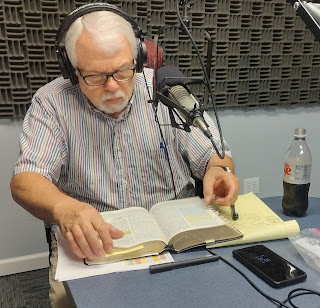
Radio Interview

    Some folks might think doing a radio interview would be extremely stressful. I think of them as a lot of fun. David Francoeur does a gre...